Best Nap Time Finder
Find your personal optimal nap window based on your wake time and chronotype — not just the generic "1–3 PM" advice everyone gives.
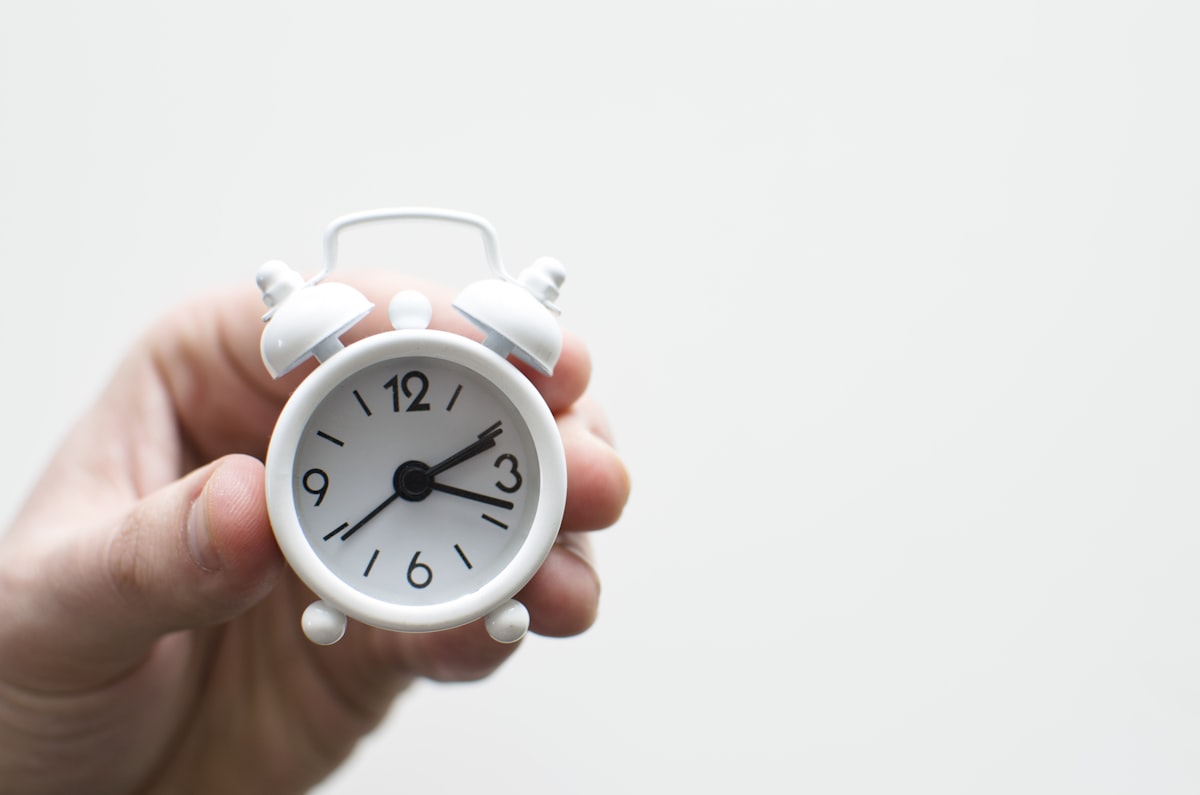
Clock showing optimal nap time -- best nap window for alertness · Photo: Unsplash
Why Nap Timing Is Personal
The commonly cited "1–3 PM" nap window is an average for a person with a typical sleep schedule who wakes around 7 AM. But nap timing should actually be calculated relative to your own wake time and circadian phase — the post-lunch dip occurs roughly 7–8 hours after your natural wake time, not at a fixed clock time. Night owls who naturally wake at 9 AM experience their circadian alertness dip around 4–5 PM, making a 4 PM nap more appropriate than a 1 PM nap for their biology.
Chronotype and Optimal Nap Timing
The optimal nap time is not the same for everyone -- it depends on your chronotype (your natural sleep-wake timing). For morning types (larks), the alertness dip and optimal nap window typically occurs earlier (12-2 PM). For intermediate types (bears), the typical 1-3 PM window applies. For evening types (night owls), the alertness dip often occurs later (2-4 PM), and a nap in this window provides better alertness restoration than forcing an earlier nap when the body is still in a relatively alert state.
The secondary consideration is nighttime sleep timing. The further the nap ends from your target bedtime, the less it impairs nighttime sleep pressure. For someone sleeping at 11 PM, a nap ending at 2 PM (9 hours before bed) has minimal nighttime impact; the same nap ending at 5 PM (6 hours before bed) has more. Use our Chronotype Calculator to find your biological timing and calibrate nap timing accordingly.
Testing Your Optimal Nap Window
The surest way to find your personal optimal nap time is a brief self-experiment: for one week, take a 20-minute nap at 12 PM; the following week, try 2 PM; then 3 PM. Track alertness for 2 hours after waking on a 1-10 scale. The window producing the highest post-nap alertness with least grogginess is your personal optimum. Most people find the 1-3 PM range optimal, but individual variation is real -- late chronotypes often find 2:30-3:30 PM more effective than the commonly cited 1 PM.
Work schedule constraints often make ideal nap timing impractical. If a 20-minute break is available, even a non-ideal time (11 AM or 4 PM) provides benefit -- just expect less alertness restoration and potentially some nighttime impact with later timing. A consistent nap time, even if not biologically ideal, still builds a conditioned pre-nap relaxation response that makes falling asleep faster over weeks of practice. Use our Chronotype Calculator to refine your nap timing based on your biological clock.
Consistent Sleep: The Foundation of All Health Goals
Whether your primary goal is physical performance, cognitive excellence, weight management, or emotional resilience, consistent adequate sleep is the biological prerequisite that enables all of them. Research across every major health domain shows that sleep-restricted individuals achieve significantly worse outcomes than their well-rested peers at equivalent effort levels. For any tool or calculation that supports a health or performance goal, the most reliable way to improve the results of that goal is to first ensure the sleep foundation is stable.
The compounding effect of consistent sleep is one of the most underappreciated phenomena in preventive health. Sleeping 7.5-9 hours at consistent times produces neurochemical, hormonal, and cellular conditions that optimize every other health behavior: exercise recovery is better, nutritional choices are more consistent (less ghrelin-driven junk food consumption), stress management is more effective, and cognitive performance across all domains improves. Use our Sleep Hygiene Score to assess and optimize the foundation that makes all your other health tools work better.